
01 Introduction: Two Buildings That Decide Whether a Camp Works
Energy sites are judged by what they produce, but they run on two things that rarely appear in a performance report: whether people can wash properly and whether they can sleep properly. Every remote camp, from a gas plant in the desert to a hydroelectric site in a river valley, depends on restrooms that function under load and dormitories that hold their interior conditions through extreme weather. When either fails, the consequences reach the whole operation within weeks, and recovering them costs far more than building them properly the first time.
Lida Group builds both as heavy-duty container systems rather than as improvised cabins. The units use steel frames and insulated composite panels, are fitted out in the factory, and arrive on site complete enough to be connected and used almost immediately. This article explains why hygiene and comfort deserve the same engineering attention as production equipment, what heavy-duty actually means in this context, and how the two building types work together to keep an energy site staffed and functioning.
02 Why Hygiene Fails First in Remote Camps
Hygiene is usually the first system to break down on a remote site, and it breaks down quietly. A restroom block sized for an average population meets a peak at shift change, queues form, and people begin to skip washing because the alternative is losing twenty minutes of rest. A water supply designed for the first phase cannot keep pace once the workforce doubles, and storage runs dry by mid-afternoon on the hottest days. None of these failures looks serious on the day it happens.
The consequences, however, accumulate. Skin conditions, gastrointestinal illness, and the general decline in morale that follows from living in conditions people cannot control all trace back to the same source, and on a site where the nearest clinic is hours away, even minor illnesses remove people from the roster. Absence rates rise quietly, shifts go short, and the camp manager starts covering gaps with contractors who have not been inducted. Hygiene infrastructure is therefore not a welfare detail but a production dependency, and it deserves to be sized, engineered, and maintained accordingly.
03 Heavy-Duty Restrooms: Engineering the Wet Room
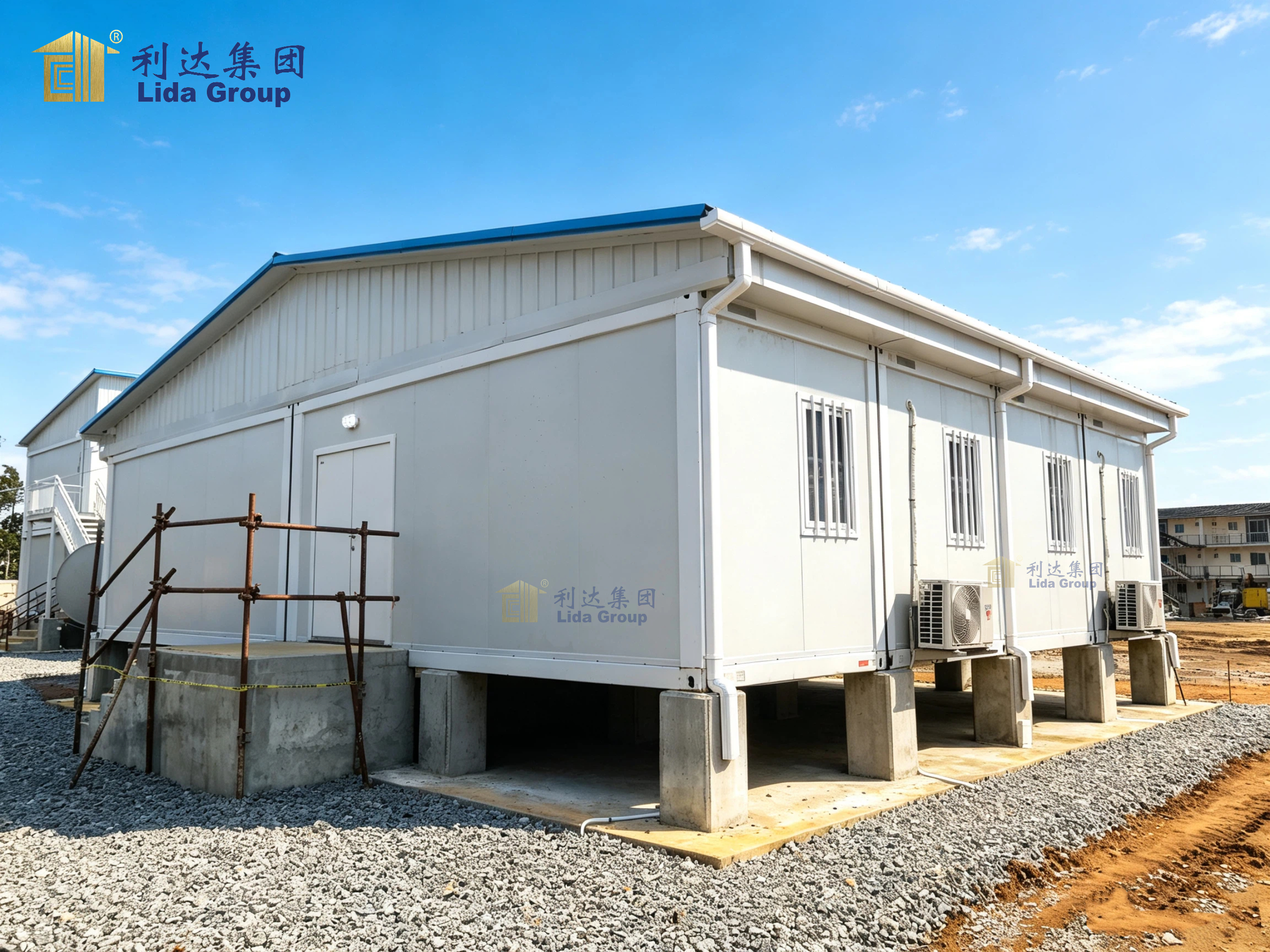
A restroom in a remote camp is a wet room under constant use, and ordinary construction does not survive that. Lida’s heavy-duty container restrooms are built to tolerate water, cleaning chemicals, and the abrasion of hundreds of daily users, with floor systems that drain properly rather than pooling around fittings, and wall surfaces that can be washed down without degrading. The frame carries the weight of the installation, and the internal layout is arranged so that services remain accessible for repair. Cleaning is a daily task performed by people who are not specialists, so the details that make a wet room easy to keep clean matter as much as the ones that make it strong.
Heavy-duty also means designed for the climate outside. Insulation prevents condensation on cold surfaces in freezing conditions and keeps interiors usable in extreme heat, while the envelope resists dust and wind-driven rain that would otherwise find its way into the fittings. Floor falls, gully positions, and door thresholds are set so that water goes where it should even when the facility is busy and the floor is wet. Because the unit is prefabricated, plumbing and waterproofing are completed and tested in a factory rather than assembled in the open on site, which is where most of the leaks in camp facilities originate.
04 Water, Waste and the Closed Loop
On an energy site, water does not arrive from a municipal network and waste does not leave through a town sewer. Both must be managed as a closed loop within the camp, and the restroom block sits at the centre of it. Lida’s units are configured to connect to the storage, treatment, and disposal arrangements the site actually has, rather than assuming infrastructure that a remote location will never provide.
This is where an integrated approach earns its keep. Greywater and blackwater routes are planned before the block is positioned, storage is sized against the design population rather than the first phase, and the connections are placed so that maintenance can be carried out without closing the facility. Where a site has no treatment capacity of its own, the restroom system can be specified with the collection and handling arrangements it needs rather than left to be improvised later by a contractor who has never seen the camp. Waste handling is part of the same plan, which means the camp avoids the pattern that so often develops on remote sites: a well-built restroom connected to a system that cannot keep up with it.
05 Dormitories: Comfort Under Load
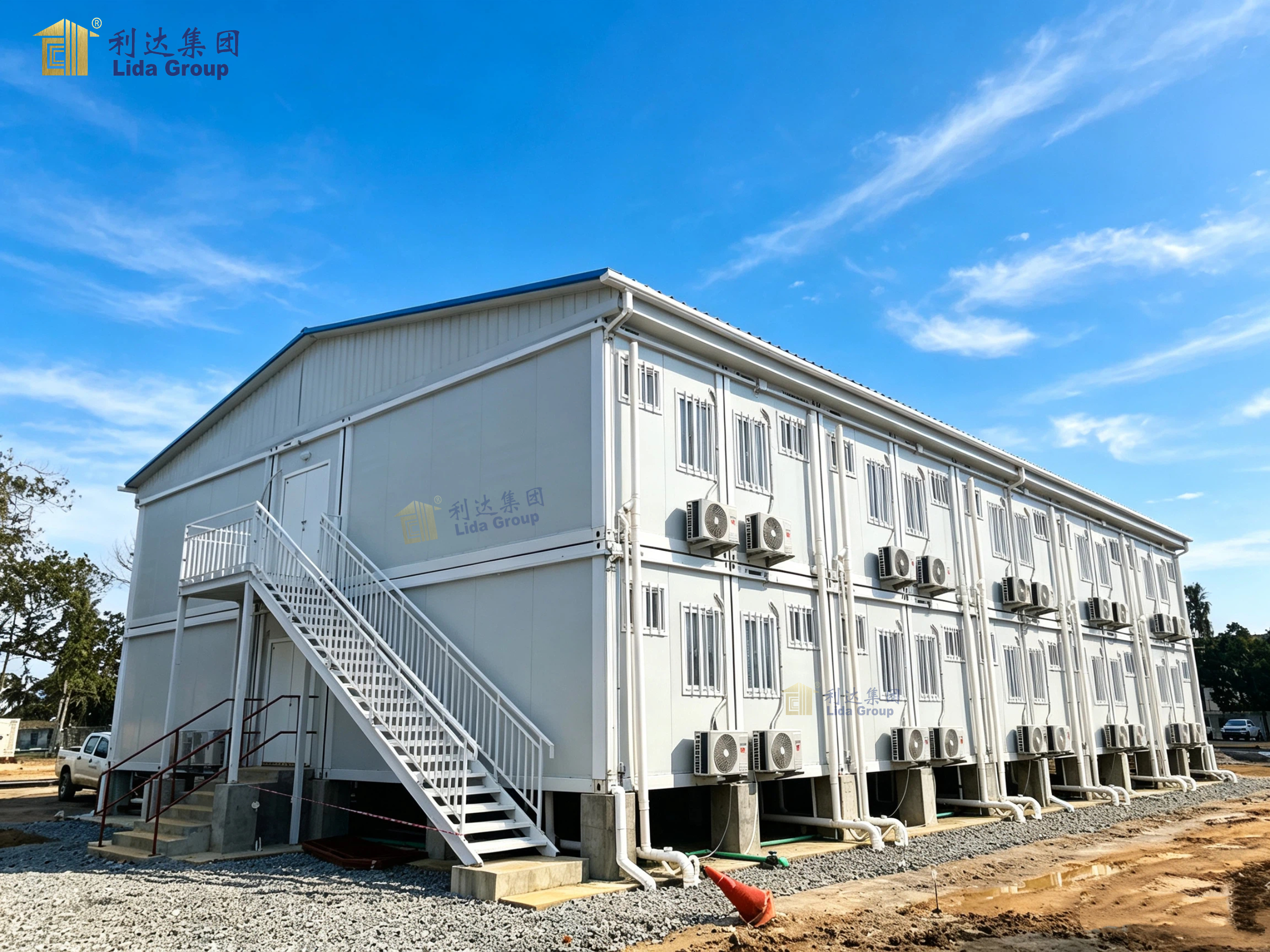
Dormitories carry a similar engineering burden in a different form. Their job is to provide restful conditions for people working long shifts in difficult environments, and that requires stable temperature, controlled humidity, reliable power, and a layout that separates sleeping space from the noise and activity of the camp outside. Lida’s dormitory containers are built to that standard, with insulated panels, sealed envelopes, and internal arrangements designed around the daily cycle of a rotation workforce.
The critical variable is not luxury but consistency. A worker returning after a twelve-hour shift needs the same conditions every time, regardless of whether it is the hottest week of the year or the coldest night of the winter. Units that hold their interior temperature without depending on fragile mechanical systems deliver that consistency, and consistency is what allows a workforce to recover enough to perform again on the next shift. Predictability also removes a source of friction that camp managers know well: when conditions vary from block to block, residents compare them, and dissatisfaction spreads through a camp faster than almost any other complaint.
06 Thermal Control and the Sealed Envelope
Thermal performance in a container building depends far more on detailing than on the nominal insulation value of the panels. Heat is lost and gained at junctions, at door and window openings, and wherever the envelope is penetrated, and those are precisely the places where site-built accommodation usually fails. Lida’s units are made in a factory where those junctions are resolved once and repeated identically across every unit, so the performance of the first dormitory matches the performance of the fiftieth.
The sealed envelope serves hygiene as well as comfort. Dust that enters a dormitory settles on surfaces, aggravates respiratory conditions, and defeats cleaning effort, and wind-driven rain that reaches the interior damages finishes and creates the damp conditions in which mould develops. Both problems are difficult to reverse once they take hold, because by the time mould is visible the material behind it is already affected. Treating the envelope as a continuous barrier rather than as a collection of panels is what allows a camp to remain clean and dry in environments that are actively hostile to both.
07 Hygiene Discipline Built Into the Layout
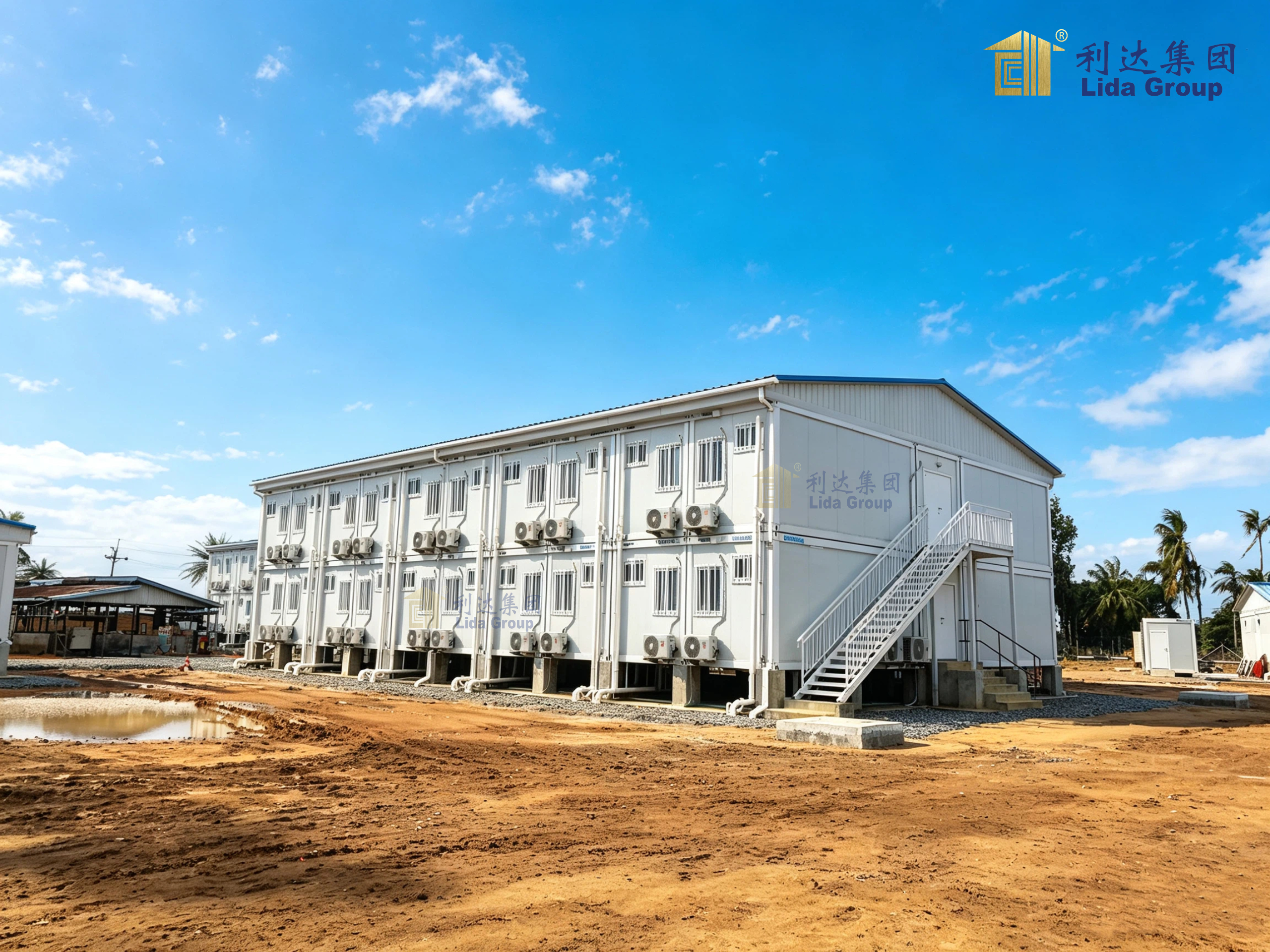
Good hygiene is partly a matter of behaviour, and behaviour follows layout. If the route from the working area to the dormitory passes a washing facility, people use it; if washing is in a separate building at the other end of the camp, they do not. Lida’s planning approach places sanitation where the daily routine already goes, so that the correct behavior is also the convenient one and does not depend on enforcement, notices, or the goodwill of a supervisor at the end of a long shift.
The same principle applies inside the buildings. Wet and dry zones are separated so that floors stay safe and cleanable, storage for cleaning materials sits within the facility so that supplies are always available, and surfaces are chosen for the cleaning regime the camp can realistically sustain rather than for an ideal that nobody will maintain. Fittings that look impressive but cannot be descaled with the chemicals available on site become a permanent defect within months. When the layout supports the routine, hygiene standards hold under pressure, and the facility stays in the condition it was designed for.
08 Durability Where Maintenance Is Scarce
Maintenance capability on a remote energy site is limited, and every design decision must assume that repairs will be carried out by a small team with standard tools. Heavy-duty construction therefore means not only strength but serviceability: components that can be replaced individually, fittings that are commonly available, and procedures that do not require specialist knowledge in every trade. Access panels, isolation points, and shut-off valves are placed where a fitter can reach them without dismantling the room around them. A facility that needs a manufacturer’s technician to restore a shower is a facility that will stay broken for weeks.
Lida’s container units are built around this reality. The steel frame resists damage from handling and impact and does not rot, warp, or attract pests, the panel system can be repaired locally, and the standardised design means that parts and knowledge carry across the whole camp. A replacement panel, a shower fitting, or a drainage component can be sourced against a known specification instead of being fabricated on site by whoever happens to be available. Units can also be relocated when a project moves, retaining their condition through transport because they were engineered for it. Across the life of a camp, that combination of robustness and repairability is what keeps hygiene and comfort available every day rather than only in the first year.
09 Conclusion: The Foundation of a Functioning Camp
Heavy-duty container restrooms and dormitories are unglamorous buildings, and they are the ones on which everything else depends. A camp where people can wash properly and sleep properly is a camp that keeps its workforce, sustains its safety record, and avoids the slow erosion of performance that follows from living in conditions nobody controls. Neither building is expensive relative to the operation it supports, yet both are frequently procured as an afterthought.
Lida Group’s approach treats them as engineered systems: sized against real populations, built for the climate they will face, connected to services planned as a whole, and maintained with parts and procedures that a site team can manage. Sanitation is positioned where the routine already passes, storage and treatment are matched to the block they serve, and the units are detailed so that a wet room stays watertight after years of heavy use rather than months. The result is hygiene that holds under peak load, comfort that holds through extreme weather, and buildings that remain reliably in service across years and relocations. For energy operators working far from anywhere, that reliability is the difference between a camp that functions and a camp that is endured.
Post time: Nov-23-2026