
Remote mining operations present unique challenges that few other industries face. Workers often live and work far from cities, in environments marked by extreme weather, limited infrastructure, and long rotations away from family. In these settings, the quality of housing and office facilities directly influences safety, productivity, retention, and overall project success. Poorly designed camps lead to higher turnover, lower morale, and operational delays. Thoughtfully designed ones support healthier, more focused teams and smoother operations.
Lida Group has spent more than three decades developing modular and prefabricated solutions tailored to these realities. Founded in 1993, the company has delivered thousands of projects across more than 150 countries, providing complete camp systems that combine durable construction, rapid deployment, and practical comfort. This guide explores the core principles of designing effective workforce housing and offices for remote mining camps, drawing on proven approaches that balance cost, speed, durability, and human needs.

Understanding the Unique Demands of Remote Mining Sites
Mining camps must function as self-contained communities. They need to withstand harsh climates—whether Arctic cold, desert heat, high winds, or heavy rainfall—while remaining easy to transport, assemble, and, when necessary, relocate. Traditional construction methods often prove too slow and expensive in these locations. Modular systems, by contrast, are manufactured under controlled factory conditions, shipped as complete or near-complete units, and assembled on site with minimal disruption.
Key considerations begin with the site itself. Access roads may be rough or seasonal. Local skilled labor is frequently scarce. Utilities such as power, water, and waste treatment must often be provided independently. Climate extremes demand strong insulation, reliable HVAC systems, and structural integrity that meets or exceeds international standards. At the same time, the design must support the daily rhythms of shift work: quiet sleeping areas for those on rest, efficient offices for planning and safety meetings, and communal spaces that reduce isolation.
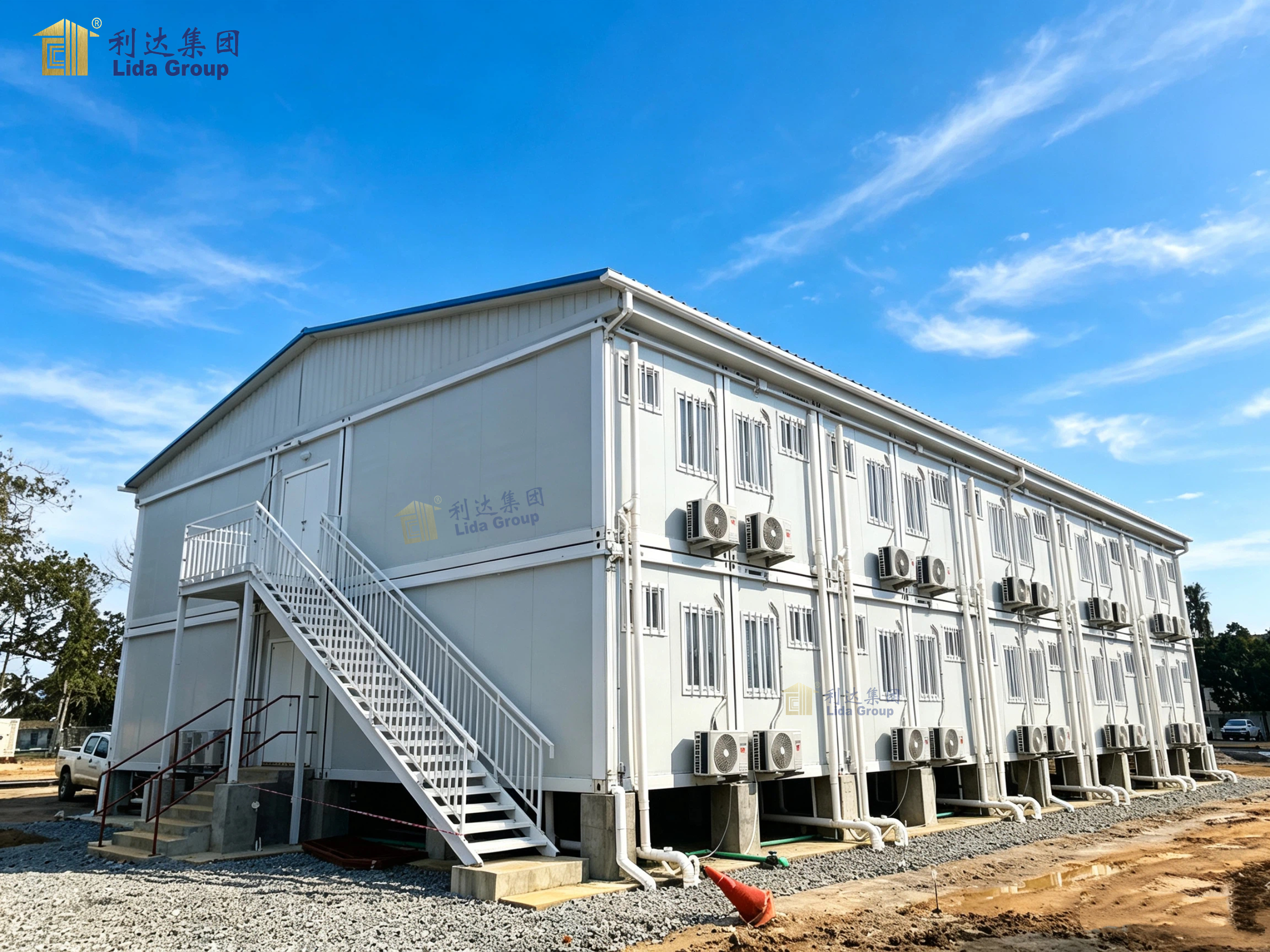
Lida Group addresses these demands through light-steel-frame structures and sandwich-panel walls and roofs. Units can be configured as single containers, multi-unit blocks, or multi-story complexes. Materials and insulation are selected according to the specific climate, and electrical, plumbing, and climate-control systems are pre-installed in the factory whenever possible. This approach reduces on-site work, shortens installation timelines, and improves quality consistency.
Designing Comfortable and Functional Workforce Housing
Housing forms the foundation of any successful camp. Workers who sleep well, feel secure, and have access to basic amenities are more productive and less likely to leave mid-project. The most effective designs move beyond basic dormitories toward spaces that respect privacy, hygiene, and rest.
Modern mining camps typically include a mix of room types. Shared dormitory-style rooms remain cost-effective for large crews, while private or semi-private rooms serve supervisors, specialists, or longer-term staff. Each unit should provide adequate storage, good lighting, and effective temperature control. Bathrooms and showers need to be plentiful, well-ventilated, and easy to maintain. Laundry facilities and drying areas prevent the spread of dampness and odors that can quickly degrade living conditions.
Communal spaces play an equally important role. Dining halls that serve nutritious meals on reliable schedules help maintain energy levels. Recreation rooms, outdoor seating areas, and quiet zones give people places to unwind. In many successful camps, these areas are deliberately designed to feel less institutional—using durable finishes that still look clean and welcoming. Natural light, thoughtful color schemes, and acoustic separation between sleeping and active zones all contribute to better rest and lower stress.
Lida Group’s modular housing solutions allow camps to scale efficiently. A project can begin with a modest number of units and expand as the workforce grows, without major reconstruction. Because modules share standardized connections, additional rooms, corridors, or entire wings can be added with relatively little downtime. The same modular approach supports different levels of comfort within one camp, so companies can offer upgraded options where they create the greatest retention benefit.
Durability remains non-negotiable. Structures must resist corrosion, impact, and extreme temperatures while remaining lightweight enough for transport. Service lives of 15 to 20 years or more are realistic when quality materials and proper foundations are used. Fire resistance, secure locking systems, and clear emergency exits further protect residents in isolated locations where external help may be hours or days away.

Creating Productive Office and Support Spaces
Offices in remote mining camps serve multiple critical functions: daily operations planning, safety briefings, equipment monitoring, administrative work, and communication with headquarters. These spaces need to be reliable, well-lit, and equipped for both focused work and collaboration.
Effective office designs typically include private or semi-private rooms for managers and engineers, open or partitioned areas for teams, meeting rooms that can host safety or production discussions, and secure storage for documents and sensitive equipment. Reliable power, robust internet connectivity (often via satellite or dedicated links), and climate control are essential. Dust, vibration, and temperature swings common near mining activity must be managed so that computers and communication equipment function consistently.
Modular office containers and buildings offer particular advantages here. They can be delivered fully fitted with electrical systems, data cabling, lighting, and furniture layouts already planned. Multiple units can be joined side-by-side or stacked to create larger complexes. Some designs incorporate elevated floors or specialized foundations that reduce the impact of ground movement or flooding. For temporary exploration phases, smaller, highly mobile office units can be deployed quickly and later integrated into a larger permanent camp.
Beyond pure office functions, support facilities such as medical clinics, security posts, warehouses, and workshops should be planned as part of the same system. Locating these close to housing and main work areas reduces walking distances and improves response times in emergencies. Clear site layout—with logical circulation paths, good lighting, and defined zones—enhances both safety and daily efficiency.
Balancing Speed, Cost, and Long-Term Value
One of the strongest arguments for modular construction is the dramatic reduction in project timelines. Factory production can proceed in parallel with site preparation. Once modules arrive, assembly often takes days or weeks rather than months. This acceleration shortens the period before the workforce can move in and operations can ramp up, directly affecting project economics.
Cost control comes from several sources. Standardized production reduces material waste and labor variability. Prefabrication minimizes expensive on-site skilled work in remote locations. Reusability and relocatable designs protect the investment: when a project ends or moves, many modules can be dismantled, transported, and reconfigured elsewhere. Over the life of multiple projects, this flexibility improves return on capital compared with permanent conventional buildings that may be abandoned.
Lida Group emphasizes a complete one-stop approach that covers design consultation, manufacturing, logistics, and installation support. Clients work with engineers who understand mining environments and can recommend configurations suited to specific climates, workforce sizes, and operational phases. The result is a camp that meets immediate needs while remaining adaptable for future expansion or relocation.
Integrating Sustainability and Worker Well-Being
Modern mining companies increasingly recognize that environmental performance and worker welfare are linked. Energy-efficient insulation and HVAC systems lower fuel consumption for heating and cooling. Options for solar supplementation or hybrid power systems reduce reliance on generators. Water-saving fixtures and careful waste management systems help camps operate with smaller environmental footprints.
From a human perspective, design choices that support mental and physical health pay measurable dividends. Adequate privacy, access to outdoor space where climate allows, good air quality, and facilities that enable exercise or social connection all contribute to lower stress and higher alertness. In an industry where fatigue and isolation carry real safety risks, these factors are operational necessities rather than luxuries.
Camps designed with clear zoning—separating noisy activity areas from sleeping quarters, placing recreational spaces thoughtfully, and ensuring safe pedestrian routes—create a more livable environment. When workers feel the company has invested in their daily experience, loyalty and performance improve.
Practical Steps for Successful Implementation
Successful camp design begins with thorough needs assessment. Project teams should define expected workforce numbers across different phases, climate and terrain data, regulatory requirements, and preferred levels of comfort. Early collaboration with experienced modular suppliers helps translate these requirements into realistic layouts and timelines.
Site planning should consider drainage, foundation types suitable for local soil, prevailing winds, and solar orientation. Transportation logistics—road conditions, port access, and lifting equipment—must be evaluated so that modules arrive undamaged and on schedule. Once on site, clear assembly sequences and quality checks ensure the finished camp performs as designed.
Ongoing maintenance planning is equally important. Modular systems with accessible components and durable finishes simplify upkeep. Training local or camp staff in basic systems care extends service life and keeps living conditions high.

Conclusion
Designing workforce housing and offices for remote mining camps is ultimately about enabling people to perform demanding work safely and sustainably under challenging conditions. The best solutions combine structural resilience, rapid and flexible deployment, practical comfort, and thoughtful site planning. Modular and prefabricated systems have proven especially well suited to these requirements, offering speed, cost control, and adaptability that conventional construction rarely matches in remote settings.
Lida Group has refined these capabilities over more than thirty years of global project experience. By focusing on durable materials, factory precision, climate-appropriate design, and complete camp systems, the company helps mining operators create living and working environments that support productivity, retention, and operational continuity. When housing and offices are designed as integrated, high-quality infrastructure rather than temporary afterthoughts, remote mining camps become stronger foundations for successful projects—wherever the resources may lie.
Contact us, please click here!
Post time: Oct-22-2026